Consumers have been trying to figure out the latest product from Apple. Part laptop, part iPhone, it's a new device that comes with a healthy price tag.
There are people far more experienced than I who can rate the attributes of the device, although I'm open to testing one (Hope you heard that, Mr. Steve Jobs). It sounds like a neat piece of technology but it may fall into a category of brilliant inventions that most people don't need.
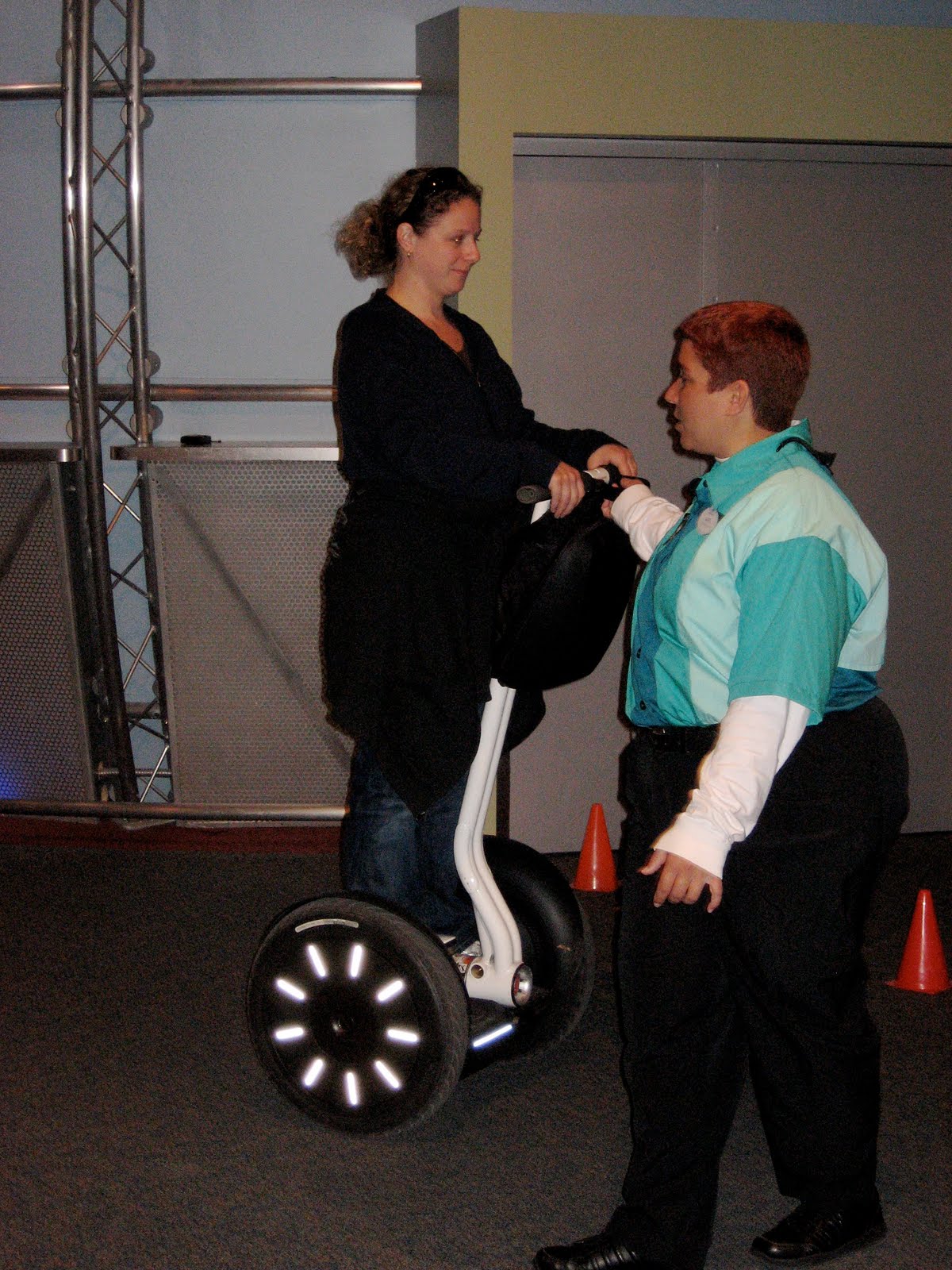
I remember back in 2001 when the world was introduced to the Segway. The personal transportation system was called revolutionary. City planners were expected to redesign cities based on the two wheeled wonder. Our landscapes were expected to be filled with these devices.
Nine years later, the Segway remains to be an interesting invention. But its use seems limited to mostly places like shopping malls and airports. Was it not a technological breakthrough? Of course it was and still is. But sometimes a good idea isn't one that's embraced by people in their everyday lives.
Both devices seem to share certain characteristics. They showcase new technology, they have high price points, and it can be difficult to market or describe in just one sentence.
I'll be curious to see if the iPad becomes a much loved and used device or whether it will take a place in history as a good machine that eventually led to something better
Showing posts with label branding. Show all posts
Sunday, April 11, 2010
Saturday, April 10, 2010
3 Lessons from my Levi's
One of the things I like about giving presentations to companies is meeting a new group of people and exchanging ideas. Recently several attendees and I had a great discussion about the power of branding.
Later while changing my clothes, I was reminded how Levi Strauss & Company is one of the best in the business at branding. Just before I stuck my legs in the jeans I noticed a printed message on the outside of the inside flap of the pocket. From this short note, I've pulled three lessons that can maximize your brand.Be Different: Often when you buy clothes the only message you get is a piece of paper telling you that it's been approved by Inspector #5 or worse, a sticker that ends up sticking to you! Some companies do have attached messages about their products. But they're gone once you remove them.
Levi's uses a non-traditional yet permanent location for its statement of principles. You can see it every time you put on and take off the jeans.
State Your Values: In a few short lines, Levi's states that you've bought an authentic pair of their jeans, their jeans have been around for more than 150 years, and that they are an American tradition that is popular worldwide.
There probably aren't a whole lot of differences between a pair of Levi's and all the other jeans on the market. But you wouldn't know that from how the company promotes itself. To them, you don't ask, "Are those a new pair of jeans?" but rather, "Are those a new pair of Levi's?"
A Call to Action: The message on the pocket also thanks the consumer for carefully examining the quality of the sewing and craftsmanship of the jeans. Instead of saying the jeans were inspected by #5, they're so confident in the workmanship, they're almost daring you to find an imperfection. Most people aren't going to carefully scan the stitches but you love the idea that it's a big deal to Levi Strauss & Company.
Keep your eye out for other good examples of branding. How a product makes you feel will likely determine whether you'll buy it.
Monday, January 18, 2010
Reputations and Perceptions
It's great that more and more businesses are offering free wireless Internet. You almost expect to the see the service in coffeehouses. I have to admit that I laughed when I saw a sign for free Wi-Fi at a Denny's restaurant.
While I haven't been in a Denny's for a long time, my memories of the chain include slow service. While I realize that it's probably illogical to think this, somehow I feel that using the Internet at a Denny's would involve a slow connection. I can't imagine any kind of speed being associated with the restaurant.
At the same time, I would imagine that McDonald's would have a fast connection. Is this because McDonald's serves food quickly?
Somehow I don't think that a potentially more crowded McDonald's would have more people online, resulting in a slower connection.
This is a good example of the irrationality of our perceptions as they can apply to a brand. If I could consider myself a test group, I might suggest to Denny's that its advertisements suggest, "lightening fast connections," in order to overcome my belief that I would be frustrated both waiting for my food and for websites to upload.
Labels:
branding,
denny's,
free internet,
ken okel,
mcdonald's,
wi-fi
Sunday, July 19, 2009
McDonalds Sips Into Success...
Recently, I opened a magazine and noticed a four page glossy advertisement from McDonalds. The interesting thing about the ad is that it had nothing to do with hamburgers, Big Macs, or fries. Instead the spread promoted the fast food chain's new speciality coffees.
In a lot of ways, it makes sense for McDonalds to aggressively pursue the coffee market. Some may want a cappuccino that falls below Starbuck's price point. McDonalds are also located all over the place (I've been told that if you're looking for a good location for a business, see where McDonalds is as that spot has been heavily researched.) so access is not a problem. And, the company already had a lot of fans of its traditional coffee (Except those who claimed in lawsuits that they were burned by the hot liquid but that's another story).
This will likely be a good example of a company extending its brand into new areas. As thing stand, I'm doubtful that it can generate much more revenue through just hamburger sales. So a company looks to see what other services it can deliver.
McDonalds has long tried to expand its product line and sometimes it hasn't worked out so well. Remember McPizza and the McDLT?
Widening a brand can be a risky proposition as is mentioned in the book, Brand Failures: The Truth about the 100 Biggest Branding Mistakes of All Time. To find out more about the book, click here. I found it to be an enjoyable read. It's easy to see, in hindsight, how many bad product decisions were made. Of course the need for more market share has long seduced executives into going too far away from what they do well.
Labels:
brand failures,
branding,
coffee,
ken okel,
latte,
mcdonalds,
new products
Wednesday, April 29, 2009
Make a Power Introduction
When you meet someone for the first time, it's very common to be asked the question, "What do you do?" I've noticed that it tends to produce dull answers. Some will say something that's immediately forgettable, like, "I do sales stuff."
That's not very good self-promotion. Would a baker say, "I make food." No, he or she would respond with something like, "I make the most amazing chocolate chip cookies that melt in your mouth and make you reach for the nearest glass of milk."
I've learned from branding experts that it's best to describe yourself in terms of what you can do for others. For example, "I help companies boost their profits through time management." That's much more powerful than saying, "I'm a consultant." The goal is to give people a taste of what you do and then be quiet. I'm suggesting silence because what you really want is to give the other person a chance to ask you a question that allows you to talk more about your expertise. If you talk non-stop, the other person will tune you out.
Avoid just saying a title as most are easily forgettable and don't really tell what you may do. I know some people with fantastic jobs but dull titles. Plus a title doesn't communicate passion for your work.
If you're on the other side of this conversation, ask the person a question about his or her work. It's a great way to build rapport with someone new.
Saturday, April 11, 2009
Religious Branding?
I've been a part of the Volunteer Income Tax Assistance program this tax season. I've helped out some people, learned a lot about taxes, and noticed something interesting when it comes to "religious branding."
When a client is itemizing their deductions, I'll check to see if he or she made any charitable contributions. I'll find out that the client did give to their place of worship. They know the amount they gave. As I'm entering in the information, I'll ask for the name of the place of worship.
"Uh, let me think about it. I'm not sure," is usually the response I get. I'm sure that the client did make the gift but it's funny that they can't remember the name right away. Often after a minute or two, it comes back to them.
Perhaps this is a case of people knowing what a place does but not knowing what it is named. For religious institutions, this may not be a problem but for a business, it's bad news.
Tuesday, March 17, 2009
When Branding Goes Bad...
I just heard a bizarre branding decision. Cable TV's Sci Fi channel will soon be changing its name to, "Syfy." Apparently the suits at NBC Universal, which owns the science fiction themed network, feel the switch will appeal to a hip new audience. Their feeling is that the more phonetic spelling will seem less geeky and more mainstream chic.
The funny thing is that the executives boast that this is all part of a rebranding strategy where more than 300 names were considered. I'd love to see what other gems were on that list.
A brand is a piece of real estate that a company owns in your brain. It's what the consumer thinks of you. Successful branding is about more than just a catchy name. If a network delivers good programs, it will find an audience, no matter what it's called.
Labels:
branding,
ken okel,
nbc universal,
sci fi channel,
syfi,
tv
Tuesday, December 16, 2008
Think About Ink
Do you put out pens for your customers to use? Do those pens tend to vanish over time? Whether intentionally or not, it's easy for people to use them and then leave with them.
If the pen is branded then you don't mind seeing it walk out the door as it's an advertisement. You could use those pens that are anchored to a desk with a cord. Yes, the pen doesn't go anywhere but the plastic chain seems to suggest that pen stealing is premeditated. If the loss of office supplies gives you angst, then try taking the cap off the pens. Suddenly it's less desirable to take because there's a chance you might get ink on yourself or your clothes if you put in in your pocket.
You're not changing the basic function of the pen but rather one detail that changes its perception. Think about how you can flip this to your advantage. What little thing can you change about your products and services that suddenly makes them more desirable. Keep in mind that from cars to iPods, people will buy a particular model because of its color, rather than what it does. A small change can have a big impact.
Thursday, August 21, 2008
Shrinkage at the Supermarket
A trip the supermarket may not fill up your cart as much as it used to. It turns out that rising gas and food prices have convinced many companies to offer their products in smaller packages. So a 16 ounce box of cereal now may only contain 14.5 ounces. The price stays the same as it was for the larger size. The companies say they are doing this instead of raising the price on the 16 ounce item.
It's an interesting strategy because the change is not immediately noticed. We tend to grab a box or a can of food by looking at the label rather than the weight. If the price seems about what it always is, we don't stop to think about it. But later on, people may notice that their breakfast cereal doesn't last as long as it used to. Now the revelation that the food companies resized their products with hardly any publicity, has some feeling resentment towards those brands.
I'll be curious to see if this business model works. Over time, people seem to accept certain market changes. I remember when $3 a gallon gas first hit the pumps. People complained but then accepted the change and kept driving.
With food, it may be different as there are more choices. For a low cost cracker, it may be very important to keep the price stable at 99 cents by shrinking the package. In this case, people buy the product because it's cheap. A high end snack may be able to get away with charging more for the same amount. Here the consumer may value taste, prestige, or quantity above cost.
Labels:
branding,
high,
ken,
marketing,
okel,
prices,
professional,
shrink,
speaker,
supermarket
Subscribe to:
Posts (Atom)